10% Off your First Order with code FIRST10. Shop Now

10% Off your First Order with code FIRST10. Shop Now
10% Off your First Order with code FIRST10. Shop Now
New national research from The Harris Poll on the gifts that drive client retention, employee engagement, and loyalty, and why thoughtfulness beats cost

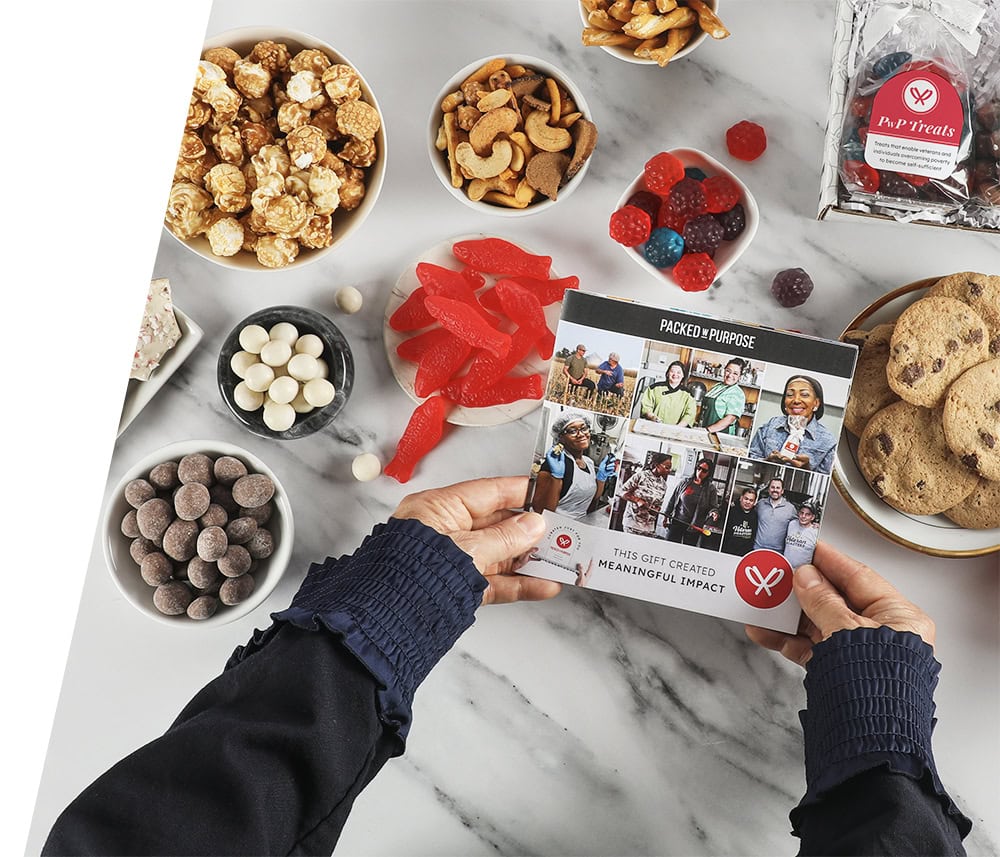
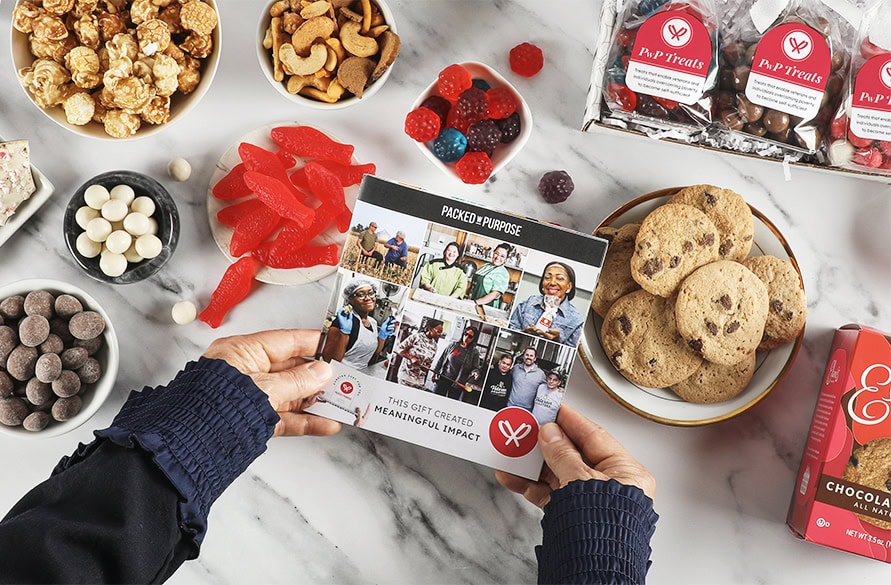

Corporate gifting is a multibillion-dollar practice, yet most of it runs on guesswork. Companies spend real money hoping a gift lands, with little idea what actually makes one work, or backfire. Few companies bring the same discernment to it that they bring to any other decision with this much sway over retention, loyalty, and referrals.
So we went straight to the people on the receiving end. Packed with Purpose commissioned The Harris Poll to survey corporate gift recipients nationwide on what separates a gift that strengthens a relationship from one that weakens it. The short answer: it isn’t budget. It’s thought, and its impact on retention, loyalty, and referrals is bigger than most teams expect.
Inside, you’ll find what your recipients truly value, why a thoughtful gift beats an expensive one, how preferences shift across generations and roles, and how to turn corporate gifting from a routine expense into one of the highest-ROI relationship tools you have.
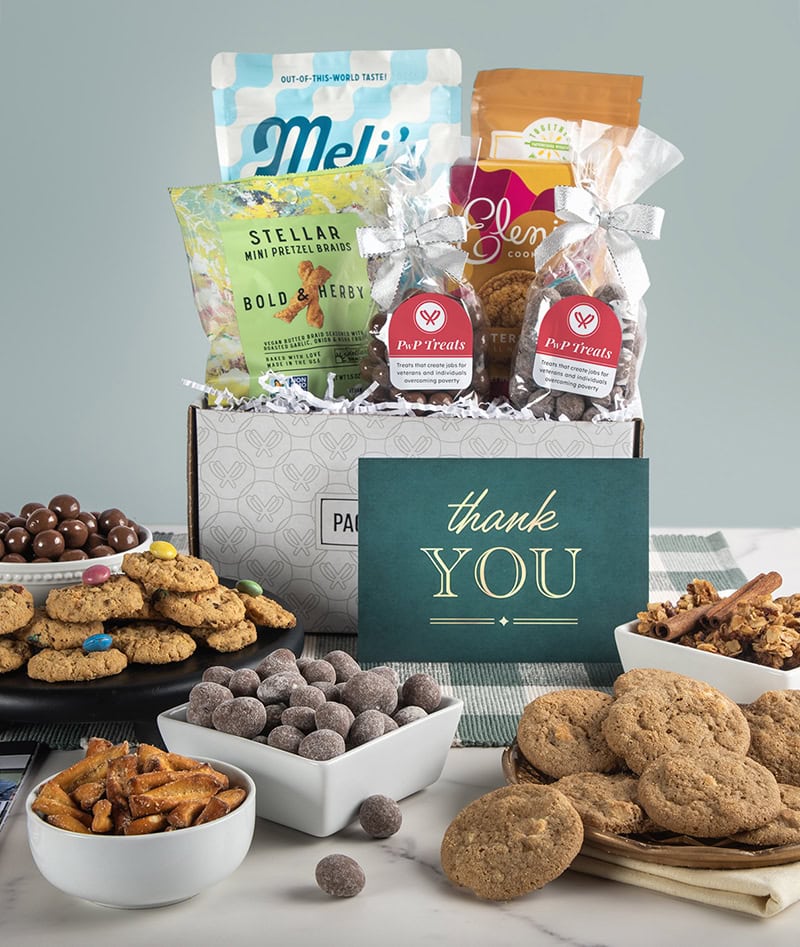
Every corporate gift is a bet on a relationship. Send the right one and you deepen a client account, keep an employee feeling genuinely valued, or turn a prospect into a conversation. Send the wrong one and you spend real budget on something forgettable, or worse, something that makes the recipient think less of you.
Getting it right is harder than ever. Few teams have the time to hyper-personalize every gift, or the budget to do it well.
We set out to replace the guesswork with data. Packed with Purpose surveyed corporate gift recipients across the United States to understand what actually makes a gift land, and what makes it fall flat. The results give organizations a clearer path to employee engagement and retention, and give sales and client-facing teams a proven way to turn gifts into loyalty and referrals.
In the pages ahead, you’ll see what your recipients truly value, why it matters, and how to build a gifting strategy that scales, without losing the personal touch that makes a gift worth giving.

To understand how recipients truly feel about corporate gifts, and how those gifts shape business relationships, Packed with Purpose commissioned The Harris Poll, one of the most established names in market research, to field a survey on corporate gifting.
The survey was conducted online in the United States by The Harris Poll on behalf of Packed with Purpose from July 23- 24, 2026. Among 2,007 adults ages 18 and older, 1,133 have received a corporate gift. These recipients answered a detailed set of questions about their experiences: who has given them corporate gifts, what they value most in a gift, and which gifts strengthened or weakened their relationship with the giver.
The sampling precision of Harris online polls is measured using a Bayesian credible interval; for this study, the data is accurate to within ± 2.7 percentage points at the 95% confidence level. Their responses form the basis of these findings.
2,007
U.S adults surveyed
1,133
had received a corporate gift

57%
of U.S. adults have received a corporate gift
Base: all U.S. adults (n=2,007)
Who did those gifts come from?

62%
an employer

33%
a vendor or service provider
33%
a client or customer
Base: gift recipients (n=1,133). Multiple sources could be selected; figures may total more than 100%.
Five data-backed findings to shape a smarter corporate gifting strategy:
Thoughtful Gifts = Positive Impressions
A thoughtful gift does more than impress. It makes people want to keep working with you.
The Risk of a Thoughtless Gift
Gifts that come across as perfunctory or impersonal can cost you a relationship. 15% said they received a gift so bad they considered it insulting.
Usefulness Beats Price
Even your wealthiest recipients aren’t worried about how much you spend. The highest earners were the most likely of all to prefer a useful, inexpensive gift.
One Size Doesn’t Fit All
73% of Baby Boomers said a thoughtful gift is one they’d actually use, compared to just 50% of Gen Z.
Give Back for ROI
No other gift type came close. A gift that gives back outperformed even personalized gifts (2x) as a driver of stronger relationships, making it both a loyalty driver and a referral engine.
Every corporate gift is a chance to move a relationship forward – and the right one drives real returns: retention, referrals, and loyalty. A thoughtful gift can turn a first-time client into repeat business, open a door with a prospect you’ve been trying to reach, and make a valued employee feel seen enough to stay. What separates the gifts that do that from the ones that don’t isn’t budget — it’s thought.
Recipients’ #1 driver of a positive impression? A genuinely thoughtful gift.
89%
think more highly of a person/company that sends a thoughtful gift

The specific items vary, but they share one thing: they signal low effort. A 2022 Business.com study1 of 1,500 professionals found the least-desirable corporate gifts all read as generic, impersonal, or an afterthought, the opposite of the thought recipients actually reward.
59%
would rather receive nothing at all than something generic
15.1%
received a gift so bad they found it insulting
The Least-Desirable Corporate Gifts
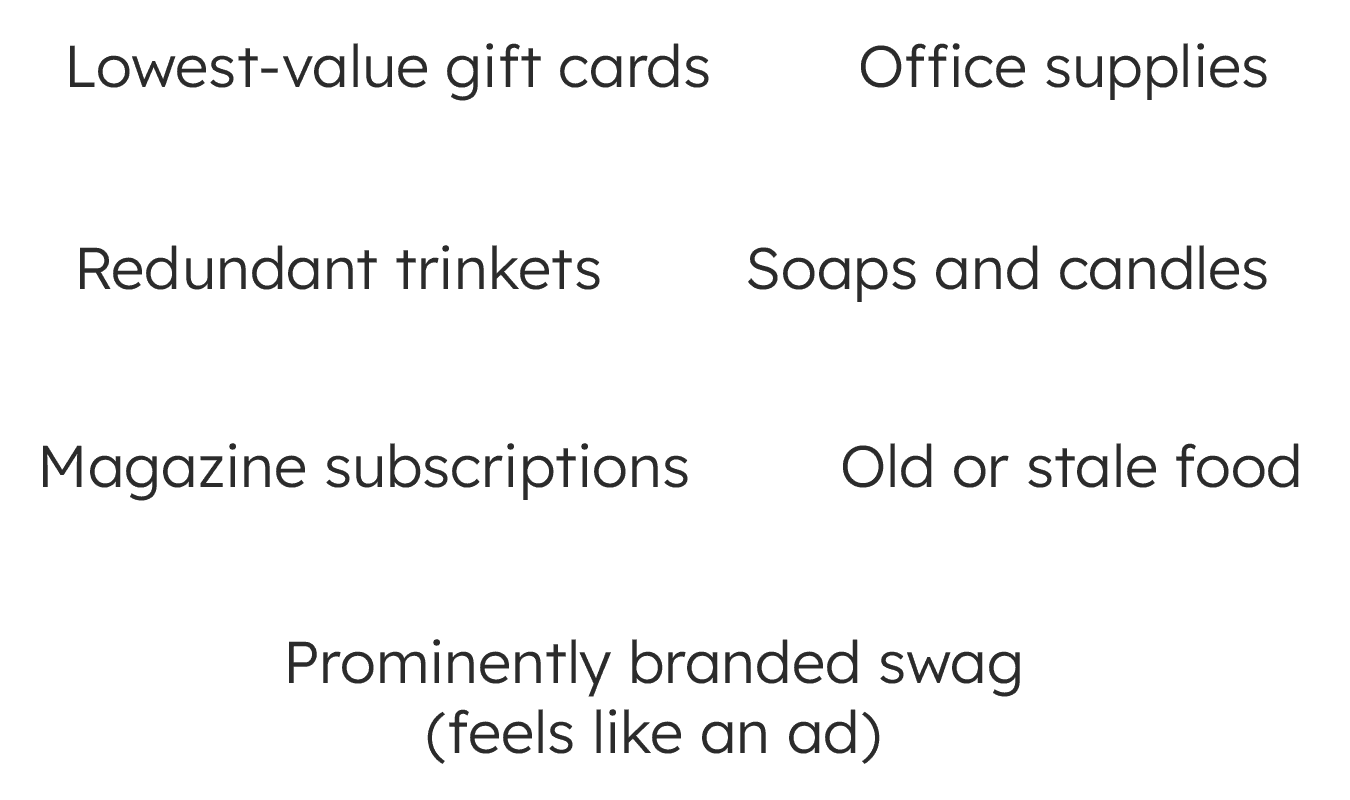
Low-value
gift cards
Prominently branded swag
(feels like an ad)
Redundant
trinkets
Old or
stale food
Magazine
subscriptions
Office
supplies
Soaps and
candles
When a gift lands well, the payoff is real: 53% of recipients said it made them feel genuinely valued, and 40% said it made them want to keep working with the sender. That is how a gift turns into client loyalty and employee retention. So how do you get there? Recipients are clear about what makes a gift feel thoughtful:
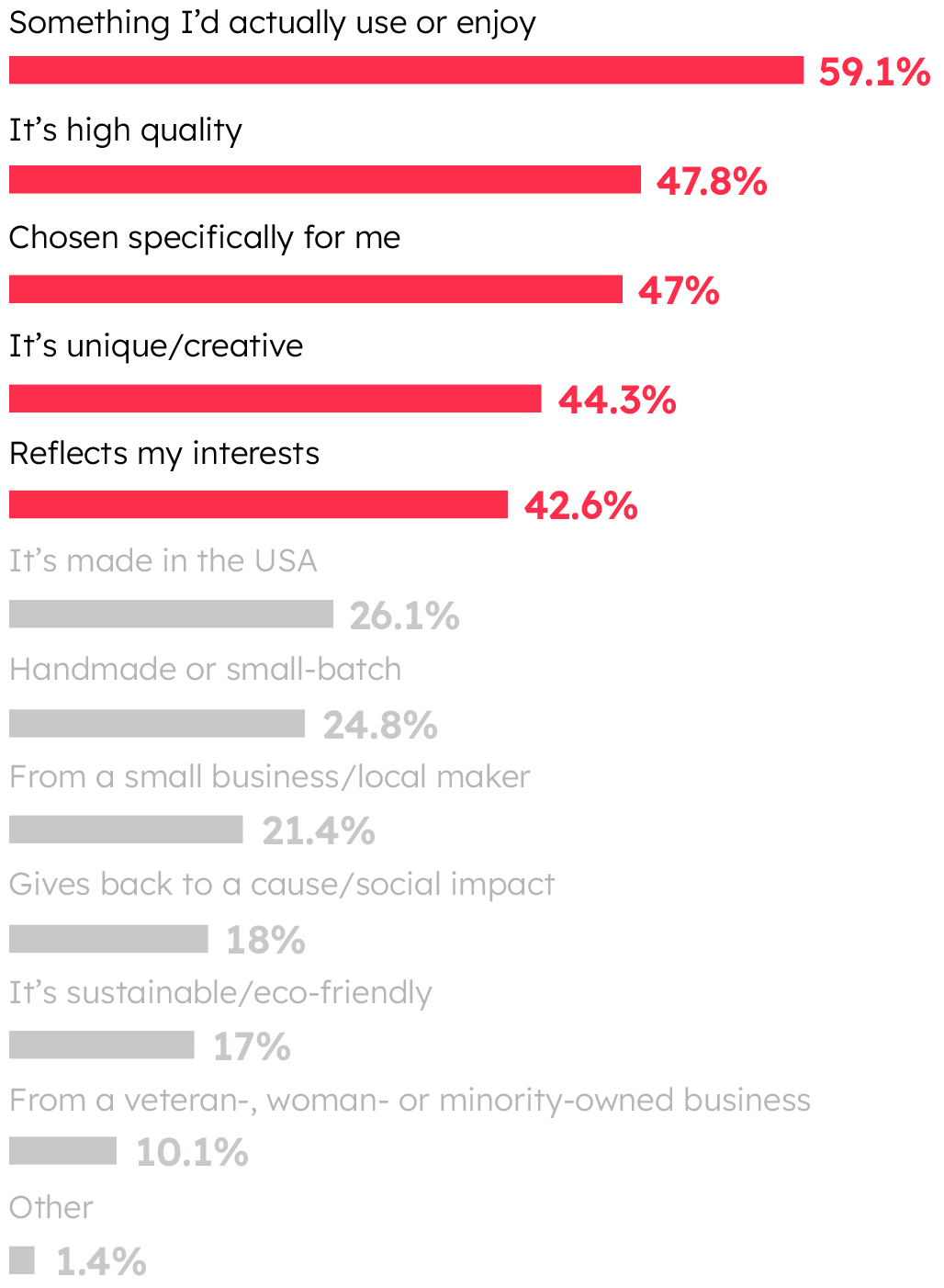
Base: gift recipients (n=1,133). Multiple responses allowed; figures may total more than 100%
Something I’d actually use or enjoy
It’s high quality
Chosen specifically for me
It’s unique/creative
Reflects my interests or values
It’s made in the USA
Handmade or small-batch
From a small business/local maker
Gives back to a cause/social impact
It’s sustainable/eco-friendly
From a veteran-, woman- or minority-owned business
Other
59.1%
47.8%
47%
44.3%
42.6%
26.1%
24.8%
21.4%
18%
17%
10.1%
1.4%
Base: gift recipients (n=1,133). Multiple responses allowed; figures may total more than 100%
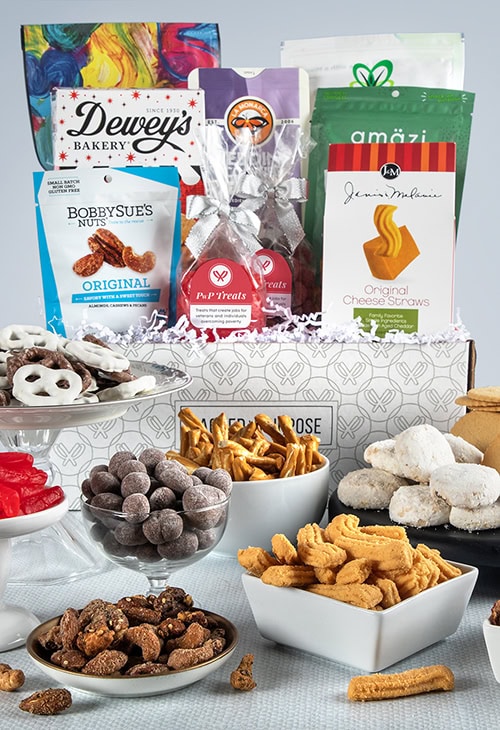
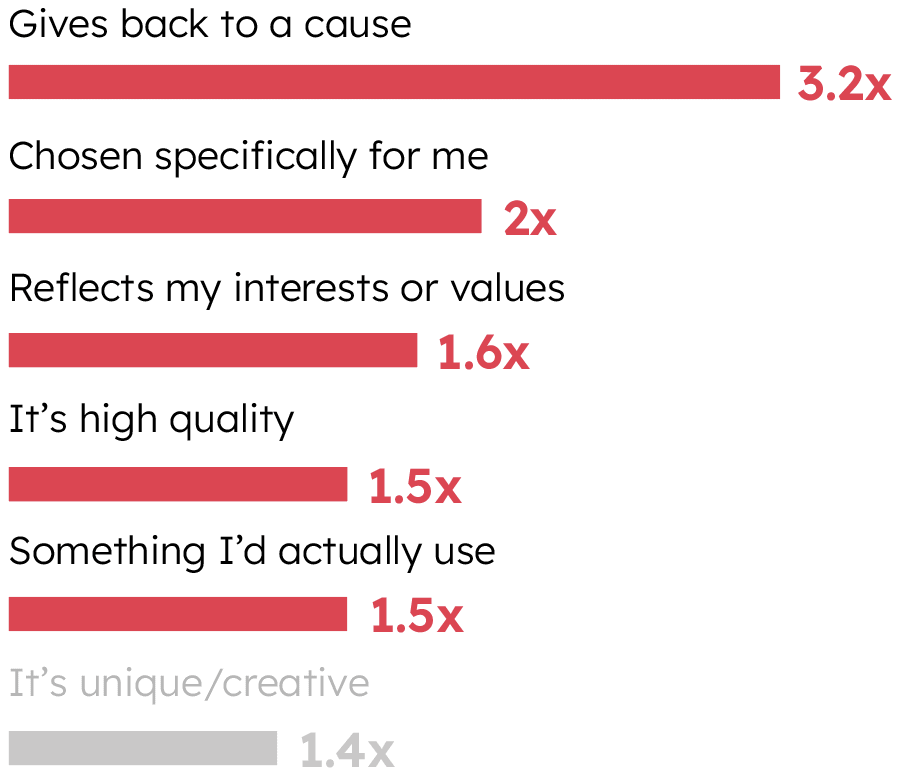
One gift type stands out for strengthening business relationships: a gift that gives back. It carries 3.2x higher odds of strengthening the relationship, far ahead of the next best options, both of which are forms of personalization. A gift chosen specifically for the individual carries 2x higher odds, and a gift that reflects the recipient’s interests or values carries 1.6x higher odds.
Gives back to a cause
Chosen specifically for me
Reflects my interests or values
It’s high quality
Something I’d actually use or enjoy
It’s unique/creative
3.2x
2x
1.6x
1.5x
1.5x
1.4x
Base: gift recipients (n=1,133). Odds ratios for strengthening a business relationship, compared to gifts without each attribute.
What does that mean for your strategy?
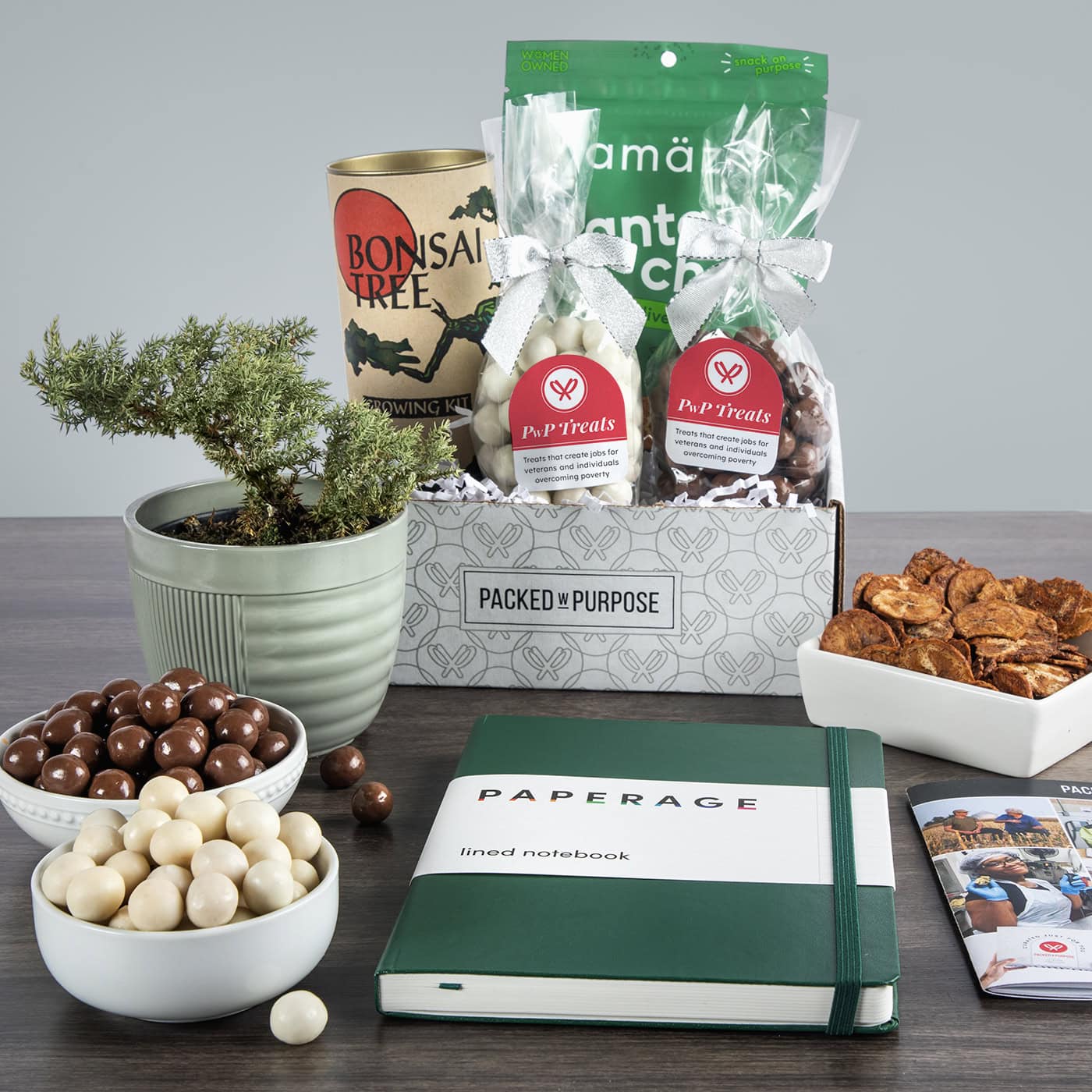
Gifts that give back are the clearest path to gifting at scale with measurable ROI. Personalizing every gift takes hours you don’t have, and it still won’t do as much as a gift that gives back to a cause.
Recipients find cause-related gifts more memorable, too: 8 in 10 say a cause-related gift beats a generic one. That memorability turns gifts that give back into engines for retention and referrals.
Employee Gift
BOOST RETENTION
80%
of employees think more highly of a company whose gift gives back
Client Gift
WIN REFERRALS
79%
of clients are more likely to tell others about a cause-related gift
What’s the ideal corporate gift budget? It’s a bit of a trick question. Given the downside of a thoughtless gift, you might assume a bigger budget buys a stronger relationship, that a high-value gift earns goodwill. It doesn’t. Recipients care far less about a gift’s price than the thought behind it.
85.5% say the thought behind a gift matters more than its cost
Thought matters more than cost
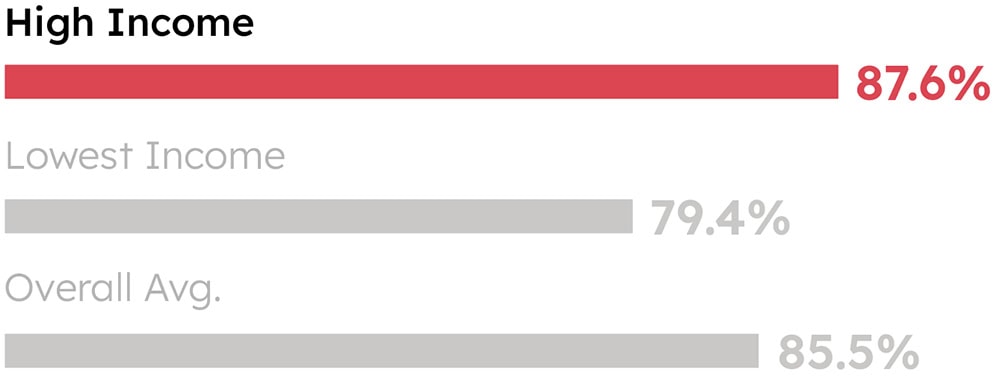
High Income
Lowest Income
Overall Avg.
87.6%
79.4%
85.5%
Base: gift recipients (n=1,133). Figures show the share who agree or strongly agree. Household income: $100K+ (n=573) vs. under $50K (n=211).
You might expect the wealthiest recipients to be the exception. They aren’t. The highest earners were even more likely than average to prefer an inexpensive gift they’ll use over a pricey one they won’t. The more someone earns, the less the price tag matters.
84.5% prefer a useful, inexpensive gift over a useless, expensive one
Prefer useful, low-cost gifts over expensive, unused ones
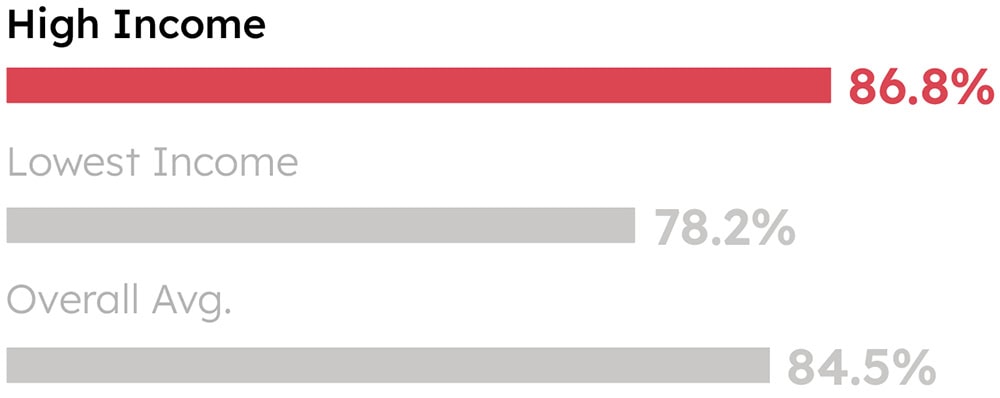
High Income
Lowest Income
Overall Avg.
86.8%
78.2%
84.5%
Employees and clients value the same gift attributes. The difference is how often they’re gifted, and what they expect behind the gift.
EMPLOYEES
Gifted often, tougher critics
74%
of full-time employees have received a corporate gift, the highest of any group
Gifted more than any other group, employees are also the quickest to spot a generic one
CLIENTS
Gifted rarely, higher expectations
$100
is what clients expect, yet the median company spends just $30 1
Just 19% of adults have received a gift from a vendor or service provider, so yours stands out
Employees and Clients Want the Same Things
Both groups rank the same top attributes at nearly identical rates
The one gap: clients rank personalization a bit higher than employees do
Usefulness
Employee: 62.3%
Client: 63.3%
High Quality
Employee: 51.5%
Client: 51.9%
Personalization
Employee: 47.9%
Client: 51.5%
Base: gift recipients (n=1,133). Employer- vs. vendor-gifted. Multiple responses allowed, totals may exceed 100%. 1 Business.com, “Does Corporate Gift-Giving Produce the Desired Outcome?” 2022.
Thoughtfulness and usefulness look different to everyone. You can’t hyper-personalize every gift, not without unlimited time and budget. But you can differentiate at scale, and the Harris Poll data shows how: use demographic groups to surface clear preferences.
Start with generation. Recipients of different ages define a thoughtful gift very differently:
53% say wasteful packaging makes them think less of the sender, versus 33% of Baby Boomers.
86% say a cause-aligned gift is more memorable (highest of any generation) and 84% are more likely to tell others. Give-back gifts turn Millennials into advocates.
63% would rather get no gift than a generic one (highest of any generation). They’ve received enough forgettable gifts to know the difference.
94% think more highly of a company that sends a thoughtful gift, 64% felt genuinely valued. They reward a gift that calls back to a past conversation and shows you paid attention.
Generation isn’t the only useful split. Employment status shapes what feels thoughtful, too.

Full Time: More likely to remember a gift for the story behind it (31.8%) than part-time workers (20.7%).

Part Time: More likely to find a handmade or small-batch gift thoughtful (39.2%) compared to their full time counterparts (21.4%).

Self Employed: Also rank handmade or small-batch gifts highly (34.9%).
So how do you turn this into a strategy that’s both personal and scalable? Consider one more data point, from a 2022 Business.com1 study:
48%
of companies send every client the same gift
If nearly half of companies send the same gift to everybody, you can set yourself apart by sending some recipients different gifts. Use these group differences to divide recipients by what they’ll likely value, then choose a thoughtful gift for each group. Finally, layer in what you personally know about individual recipients.
It’s an effective way to give a gift that feels personal and still scales within a sensible budget.
Actionable Examples
FOR CLIENTS:
Combine what you know about your clients with generational preferences to build a scalable, memorable program. Create a few gift options, each suited to a generation: a sustainability-focused gift with a charitable component for Gen Z and Millennial clients, and a high-quality, useful gift for Gen X and Boomer clients. Check with each client’s main contact, then sort recipients into the option they’ll most appreciate.
FOR EMPLOYEES:
For a mixed full- and part-time team, start by segmenting full-timers by team. Since full-time employees are the most likely to remember a gift for the story behind it, ask team leaders what story will best resonate with their group. For part-time employees, choose meaningful cause-related gifts featuring handmade or small-batch items from a local maker or organization.
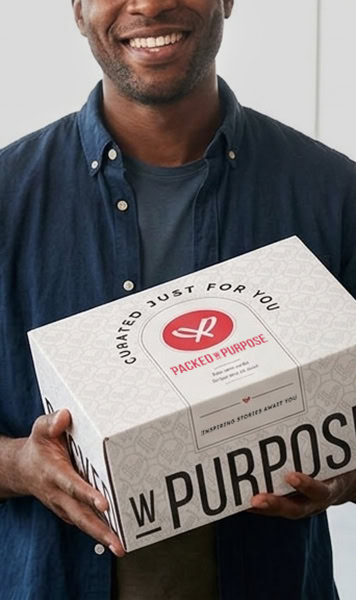
Corporate gifting is an investment in your relationships, and the clearest ROI is retention and new business. The right gift helps you keep the talent and clients you have, and opens doors to the ones you want.
HR leaders know what it costs to lose valuable talent. Client-facing teams know what it costs to replace lost business and acquire new accounts. Both are steep:
COST TO REPLACE AN EMPLOYEE
Up to 200%
of their annual salary3
COST TO aquire new business
Up to 25x
more costly than retaining existing business4
And retention compounds: Bain & Company found that lifting customer retention just 5% can increase profits by up to 95%5
The right gift drives both retention and referrals. The question is which gifts do the work, and by how much. Recipients indicated the #1 gift for strengthening a business relationship is one that gives back. Here’s what else moves the odds:
Gifts most likely to strengthen a business relationship
3.2x
a gift that gives back to a cause
2.0x
a gift chosen specifically for the recipient
1.6x
a gift that reflects the recipient’s interests or values
This data makes it clear that thoughtfulness has measurable ROI. When we review the findings by clients and employees, we get even more insights on the business value of a thoughtful gift.
Referrals require two things: trust, and a relationship memorable enough to mention. A cause-aligned gift builds both.
78.9% of clients are more likely to tell others about a gift that gives back.
A gift that gives back also strengthens the relationship itself, with 3.2x higher odds, making it one of the most effective ways a client-facing team can drive both referrals and loyalty.
Two more factors make your gift stand out
Scarcity: only 19% of people have received a corporate gift from a vendor or service provider. Most of your clients aren’t getting one, so yours stands out instead of blending in.
The personalization gap: 82% of B2B decision-makers say a customized gift is best, but only 32% have received one6.
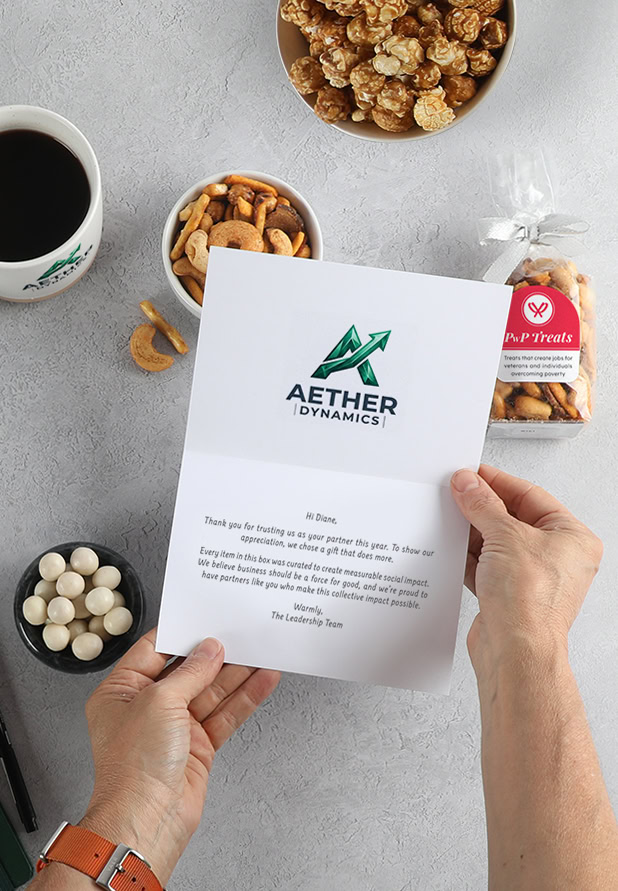
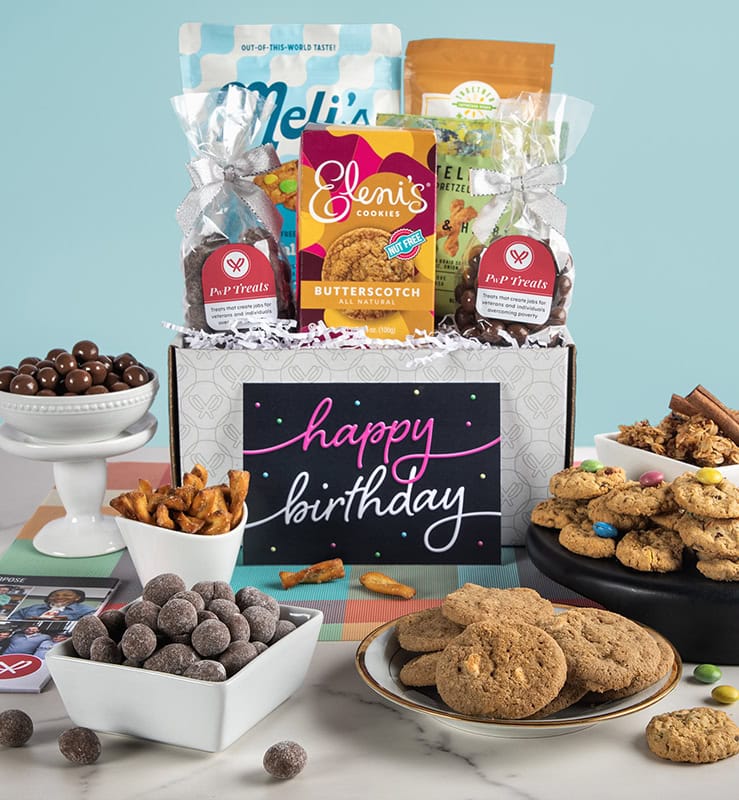
For employees, a thoughtful gift pays off in loyalty:
40.8% of full-time employees said a good gift made them want to keep working with their employer.
Two Reasons Full-Timers Are the Hardest to Impress
Volume: 74% have received a corporate gift, the highest of any group.
Scrutiny: Nearly 1 in 5 (19%) said a gift felt so thoughtless it made them think less of the sender.
Across both client and employee recipients, the evidence is clear: thoughtful gifting delivers real ROI. A corporate gift is not simply a nice gesture. It is a strategic investment in the relationships that drive retention, loyalty, and referrals. Recipients consistently reward care over cost, usefulness over extravagance, and purpose over generic giveaways.
Most telling of all, a gift that gives back is the single strongest relationship-building lever in the Harris Poll data: it raises the odds of strengthening a business relationship by 3.2x and makes recipients more likely to recommend the company behind it. For employers and client-facing teams alike, the message is the same. A gift should make people feel seen, valued, and connected to something that matters.
The opportunity then, isn’t to spend more, but to gift more intentionally. By choosing useful, high-quality gifts that give back to a cause, and grouping recipients by what they actually value, companies can personalize at scale and turn a routine expense into a genuine retention and referral engine. The most effective gifting strategies don’t try to impress everyone with the same expensive item. They use what you know about your recipients to deliver something that feels genuinely considered. In 2026, thoughtfulness isn’t a soft metric. It’s the strategy behind a gift that gets remembered, and the foundation for relationships that last.
Explore our interactive data tool to uncover insights for your gifting strategy and choose specific charts to embed on your website.
When you’re ready to put those insights into practice, Packed with Purpose can help you build a thoughtful gifting program that supports retention, loyalty, and referrals through gifts that give back.